
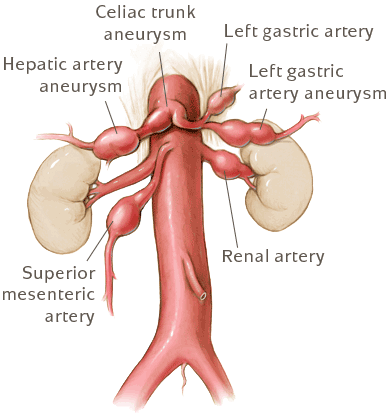
Aneurysms are bulges due to areas of weakening in the wall of the blood vessel. Since arteries are blood vessels that deliver oxygen- and nutrient-rich blood, under blood pressure generated by the heart, the driving pressure within causes the weakened areas of the artery (aneurysm) to expand. Just as a balloon can burst, aneurysms can rupture and cause catastrophic bleeding and cessation of blood flow downstream, threatening the viability of organ that the artery supplies. There are multiple reasons why aneurysms develop and the majority are due to atherosclerotic degeneration. Atherosclerosis is the disease process where cholesterol abnormally deposits within the layers of the artery, inciting repeated inflammatory responses and calcification to produce plaques. This leads to hardening of the arterial wall as more of the vessel wall is replaced with diseased plaque, losing its elasticity which is needed to accommodate pulsatile flow. As a result, these diseased areas weaken with time and aneurysms develop.
Most aneurysms are fusiform, where the wall of the diseased artery is circumferentially affected, and the resultant aneurysm is spindle shaped. Some aneurysms are saccular in shape where only a patch of wall is weakened, and an a berry shaped outpouching develops. Some vascular experts believe saccular aneurysms have a higher tendency to rupture, and hence considered more dangerous. Aneurysms can also develop if the diseased wall splits in layers as when an arterial dissection occurs. The normally bound 3-layers of the arterial wall when dissected (split) is weaker and can become aneurysmal. Connective tissue diseases such as Ehlers-Danlos syndrome and Marfans’ Disease affect collagen production, which is important for arterial wall strength. These familial and genetic conditions can also predispose to aneurysm formation. Bacterial infections that seed into the arterial wall from the blood stream can cause inflammation (vasculitis) that lead to infected mycotic aneurysms – which carry a high risk of rupture. Blunt or sharp injury (trauma) to an artery can develop into aneurysm in time if the vessel does not heal properly.
Aneurysms can occur anywhere in the arterial tree and can therefore cause a variety of problems depending on its location. There is also a direct size-to-rupture risk correlation, i.e., the bigger the size – the higher likelihood that it will rupture. The biggest artery in the body is called the aorta, which leaves the heart in the chest (thorax) and travel into the abdomen, giving important branches along its course. Thoracic and Abdominal Aortic aneurysm both carry significant risk of rupture if they become large. 6.0 cm and 5.5 cm diameter measurements in the chest and abdomen, respectively, are clear indications to recommend surgical repair. Occasionally, clots that form on the inside wall of the aneurysms can flick off and travel (embolize) into an arterial branch distally and block off blood supply. If this happens to the intestinal (mesenteric) artery it can lead to bowel death requiring emergency surgical resection, or if in the lower extremities can lead to acute limb ischemia requiring emergency revascularization to prevent an amputation. Blue toe syndrome is when small clots shower downstream and block off blood supply to the toes of the patients, rendering it blue (cyanotic) due to inadequate blood supply. Thoracic Endovascular Aortic Aneurysm repair (TEVAR) and Endovascular Abdominal Aneurysm Repair (EVAR) are minimally invasive techniques that are safe, effective, and can be offered to most patients other than open vascular surgery repair.

Cerebral aneurysms affect the main arteries to the brain and are also prone to enlargement and rupture. Increasing size can present as persistent, severe headaches, or eye signs – as the aneurysm presses on the nerves that control eyeball movement. Patients can complain of double vision or can be noticed to have developed a squint. It typically affects younger patients (3rd to 7th decade of life), can run in the family, and be part of other vascular syndromes (Ehlers-Danlos, Loeys-Dietz, Marfan’s syndromes). Cerebral aneurysm ruptures lead to subarachnoid hemorrhage (SAH) and stroke and is characteristically described as the worst headache imaginable – akin to a sledgehammer hit on the skull. SAH and strokes can be fatal or severely debilitating.
Visceral and Renal aneurysms often do not cause any symptoms and are frequently diagnosed incidentally when imaging tests (ultrasound scan, CT-scan, MRI-scan) are done for other medical conditions. Visceral aneurysms affect the gastrointestinal system responsible for our digestion, while Renal aneurysms affect the blood supply to our kidneys. Both are prone to rupture when they reach a certain size (3-cm) and can lead to internal bleeding, vital organ failure, and death. While small aneurysms can be monitored with serial imaging (6-monthly), a rapidly increasing aneurysm (> 5mm diameter increase over 6-month period) should undergo open surgical or endovascular repair. Certain bacterial infections such as Salmonella, Streptococcus, and Escherichia coli can cause mycotic mesenteric aneurysms. Visceral and Renal aneurysms of any size in women of reproductive age should be offered surgical or endovascular repair due to its high risk of rupture during pregnancy that may put both lives (mother and unborn child) at risk.
Peripheral Aneurysms (PA) occur in the upper and lower limb arteries, the latter of which is commoner. PAs can rupture and bleed, embolize, or clot off altogether – all of which carry substantial risk to limb loss and amputation. Open vascular repair remains the mainstay of treatment approach due to the presence of joints and increased mobility in the limbs which do not favor deployment of rigid endovascular stents. However, advancements in endovascular biomedical engineering have given rise to more flexible covered stents which can now be used to treat PAs minimally invasively, in selected patients.
Aneurysms are important vascular diseases that require careful evaluation, diagnosis, and management strategy to prevent catastrophic bleeding, organ failure, limb or life loss. Small aneurysms can be watched but a carefully curated monitoring schedule should be established by the vascular specialist for the patient. Early intervention should be sought for rapidly growing, symptomatic, and large aneurysms with careful consideration of each patient as to which is best therapy. Our vascular specialists at PanAsia Surgery are expertly skilled and up-to-date with the latest surgical techniques to treat this dangerous condition.